brightonSEO April 2026: 9 Key Takeaways You Need to Know
brightonSEO returned to the seafront in late April and early May 2026, and as ever, the agenda reflected exactly where the industry’s head is at.
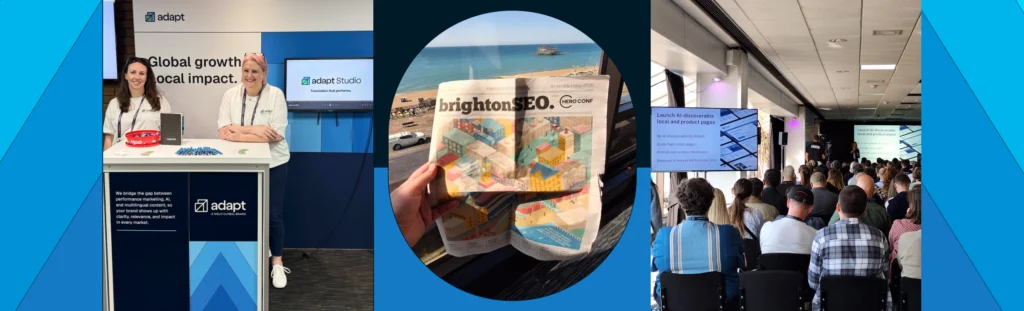
brightonSEO returned to the seafront in late April and early May 2026, and as ever, the agenda reflected exactly where the industry’s head is at. This year, the overriding theme was impossible to miss: AI has stopped being a topic at search conferences and started being the lens through which every other topic is viewed. Here are nine key takeaways from brightonSEO April 2026, covering AI search optimisation, generative engine optimisation (GEO), schema markup for AI Overviews, and what it all means for your visibility strategy.
1. AI Bots Now Account for ~12% of Website Traffic
One of the most concrete data points to come out of Brighton this year: AI crawlers and agents are estimated to account for approximately 12% of website traffic across the web. That’s no longer a rounding error. It has direct implications for server capacity, for log file analysis, and, critically, for how we think about “visitors.” Not all traffic is human, and the entities consuming your content increasingly include the AI systems that will summarise, cite, or ignore it for millions of real users.
2. Schema Markup Can Lift AI Overview Visibility by Up to 1,500%
Structured data has long been considered good SEO practice. At BrightonSEO 2026, the scale of its impact on AI search came into sharp focus. Experiments presented at the conference showed schema markup lifting visibility in Google AI Overviews by up to 1,500%, a number striking enough to reframe how teams prioritise technical implementation work.
The same experiments showed that gains in Google AIO visibility didn’t automatically translate to ChatGPT citations, underlining that each AI platform has its own signal logic. The lesson: structured data is no longer optional, and implementation strategy needs to account for platform differences.
3. We Need New Metrics: the Old Ones Are Broken
One of the most practically useful frameworks presented at the conference introduced a 3-layer model for measuring success in the AI search era. The old model built around rankings, organic clicks, and CTR is breaking down as AI-generated answers resolve queries without any click taking place. The framework replaces it with three layers: Presence (is the brand appearing in AI answers, and how?), Readiness (is the site structurally prepared to be surfaced by AI crawlers?), and Business Impact (is AI visibility actually translating into pipeline or revenue?). Each layer requires different tools and different KPIs.
A complementary session argued that the industry has been slow to acknowledge how profoundly zero-click growth has undermined the way we report value to clients and stakeholders. For any brand investing in SEO and AI search, updating how you measure and communicate impact is just as urgent as updating your tactics.
4. YouTube Is the #2 Most-Cited Social Platform in LLMs
Analysis of 5.7 million AI citations surfaced a finding that should change how content teams think about channel mix: YouTube is the most frequently cited social platform in LLM-generated answers.
What makes this particularly interesting is what does not drive citation frequency: views and likes have minimal influence. What matters is channel activity, relevance, and how well content answers the questions AI systems are trying to resolve. For brands investing in content strategy, this is a meaningful signal: video content that demonstrates genuine expertise and answers real questions is being surfaced in AI answers at scale.
5. Reddit Is Effectively a Database for AI Models
Multiple sessions across the two days returned to the same point: Reddit is not just a community platform, it’s one of the most influential inputs to how LLMs form their understanding of products, brands, and topics. Real conversations, unfiltered opinions, and community-validated responses are disproportionately represented in what AI systems have learned and continue to learn.
For brands that have historically ignored Reddit or treated it as a reputational risk rather than an opportunity, the calculus has changed. Being present in relevant communities, authentically, is increasingly part of being visible in AI search.
6. Technical SEO Is the Foundation, and It’s More Important Than Ever
Against a backdrop of AI-first conversations, several sessions served as a reminder that none of the higher-order strategy matters if the technical fundamentals aren’t in place. Crawlability, page speed, JavaScript handling, and structured log analysis remain foundational, but the stakes have risen. Pages that AI crawlers cannot access reliably simply don’t exist in the AI search ecosystem. Sessions on ecommerce migration traps, structured data for conversational search (including NLWeb and JSON-LD), and automated SEO auditing all pointed to the same conclusion: technical excellence is now the price of admission to AI search visibility, not just a performance optimisation. This is where solid SEO foundations pay dividends in the AI search world too.
7. The Entity Signal Stack Is Replacing Traditional Keyword Strategy
Multiple sessions addressed what is emerging as one of the most significant structural shifts in search optimisation. Keyword targeting, while not dead, is giving way to entity clarity: the degree to which search engines and AI systems can confidently understand who a brand is, what it does, and how it relates to the topics its audience cares about.
Building topical authority, establishing machine-readable brand signals, and maintaining consistency across the digital footprint are becoming the core of how visibility is earned. Information gain, providing something genuinely new rather than a restatement of what’s already indexed, is increasingly the differentiator for both SEO and AI search performance.
8. AI Is Reshaping How We Think About Audience, Not Just Algorithms
Several sessions pushed back against the tendency to frame AI search as a purely technical challenge. The argument made was that the fundamental question hasn’t changed: do you understand your audience well enough to produce content that genuinely serves them? AI systems are, in a sense, sophisticated audience proxies.
They surface what real people, across millions of queries, have found credible and useful. Chasing algorithmic signals without that underlying audience understanding produces content that neither humans nor AI will value. Getting AI search right starts with getting your audience understanding right.
9. Trust Is Now a Search Strategy
The thread running through almost every session at brightonSEO 2026 was trust. The businesses being cited by AI systems are the ones those systems have the most reason to believe.
That belief is built through depth, consistency, third-party validation, and genuine expertise made visible online. It is not built through volume. It is not built through optimisation shortcuts. In the AI search era, trust is the strategy, and both SEO and AI search are the mechanisms for building and demonstrating it.
The Bigger Picture
brightonSEO 2026 didn’t signal the death of SEO. It signalled its maturation into something broader, harder to game, and more closely aligned with what actually makes a business worth recommending. The rise of AI search doesn’t replace SEO: it extends it. Brands that invest in both, with strong technical foundations, clear entity signals, and genuinely useful content, are the ones that will be visible whether a user is searching on Google or asking an AI assistant.
If you want to understand what that means for your business and how to act on it, that’s exactly what we can help with.
Sources & Further Reading
1. Searchengineland.com – Schema and AI Overviews: Does structured data improve visibility?
2. Semrush Blog – The Most-Cited Domains in AI: A 3-Month Study
3. Adweek – YouTube Overtakes Reddit as Go-To Citation Source on AI Search
4. Agile Digital Strategy – brightonSEO April 2026: Two Days Of AI Search Conference
5. Position Digital – 150+ AI SEO Statistics for 2026
Let’s Talk
Ready to Win in AI Search?
Adapt’s SEO experts help you build visibility that matters in Google, in AI Overviews, and in the answers your customers are actually seeing.