AI Model Usage in Europe 2025-2026: Which Countries Use ChatGPT, Claude and Generative AI Most?
More than a third of all adults across the EU now use AI tools on a regular basis, according to Eurostat data published in December 2025.
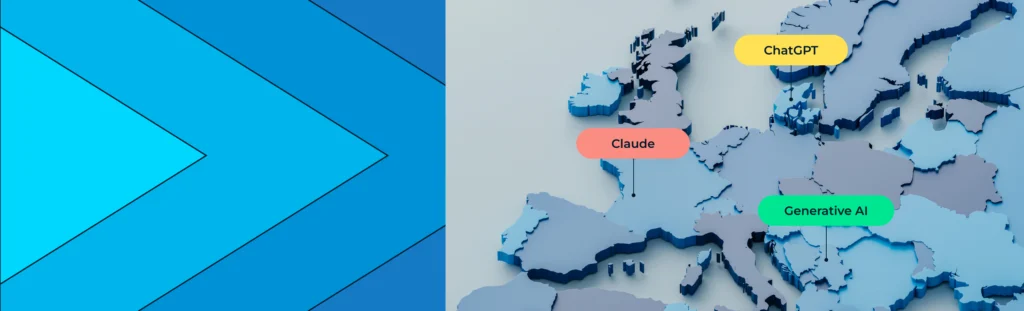
More than a third of all adults across the EU now use AI tools on a regular basis, according to Eurostat data published in December 2025. Spanning 33 countries from Copenhagen to Bucharest, the data reveals a continent of sharp contrasts: ChatGPT commands roughly 80% of European chatbot traffic, yet adoption rates swing from 56% in Norway to just 18% in Romania. For global brands with multimarket ambitions, understanding where Europeans are using AI and which tools they trust is no longer optional. This article breaks down the AI statistics and market data by country, analyses which models lead in Europe, and translates these AI trends into actionable guidance for brands scaling across the region.
Generative AI Adoption by European Country in 2025: The Full Rankings
AI adoption across Europe mirrors the broader pattern of digital investment, with Nordic and Baltic markets once again setting the pace. Denmark, Finland, Sweden, Estonia and Norway sit at the top of the rankings, while Southern and Eastern European markets, including Italy, Romania, Poland and Bulgaria, trail behind. The gap is shaped by differences in digital infrastructure, language proximity to English, and the pace of enterprise technology investment. For brands planning multimarket expansion, this divide defines where AI-driven content and discovery strategies will have the greatest immediate impact.
| COUNTRY | USAGE 2025 | TIER |
| Norway (non-EU) | 56% | High |
| Denmark | 48% | High |
| Switzerland (non-EU) | 47% | High |
| Estonia | 47% | High |
| Malta | 46% | High |
| Finland | 46% | High |
| Ireland | 45% | High |
| Netherlands | 45% | High |
| Greece | 44% | High |
| Spain | 38% | Moderate |
| France | 37% | Moderate |
| Germany | 32% | Moderate |
| Poland | 23% | Low |
| Italy | 20% | Low |
| Romania | 18% | Low |
Source: Eurostat, December 2025 (individual usage; Euronews country analysis)
Young Europeans Are Leading the Way: Gen AI Among 16 to 24 Year-Olds
If overall adoption figures look uneven, the picture among young people is far more uniform and far more striking. According to Euronews reporting on Eurostat’s February 2026 age cohort data, 63.8% of 16 to 24 year-olds used generative AI tools in 2025. In Greece the figure reaches 83.5%; in Estonia, 82.8%; in Czechia, 78.5%. Even in the EU’s lowest-adoption countries, younger cohorts are using these tools at rates that dwarf the general population.
“Among 16 to 24 year-olds, generative AI adoption reaches 63.8% across the EU, making it nearly as routine as using a search engine.”
EUROSTAT, DECEMBER 2025
This generational shift has direct implications for how brands connect with audiences across Europe. The cohort now entering the workforce, and shaping purchasing decisions, already treats AI tools as a default layer of search, discovery and decision-making. Brands that are not visible within these surfaces risk being invisible to their most commercially active future audience. Reaching this generation requires content and paid strategies that are built for AI-mediated environments, not retrofitted for them.
Enterprise AI Adoption in Europe: Scandinavia Pulls Ahead
Eurostat also tracks AI adoption at the firm level. Its December 2025 enterprise data show the concentration at the top is even more pronounced than for individuals. Denmark’s enterprises lead the bloc at a remarkable 42% adoption rate, followed by Finland at 37.8% and Sweden at 35%. These three countries alone form a cluster that is roughly twice as integrated with AI as the EU average of around 20%.
At the other end of the scale, Romanian businesses report just 5.2% AI adoption; Polish firms, 8.4%; Bulgarian companies, 8.6%. These markets are not simply slower adopters. They represent a genuine strategic opportunity. Brands that enter now with localised, culturally relevant content built for traditional search alongside emerging AI surfaces can establish authority before AI-native competition intensifies. Early positioning in lower-adoption markets is increasingly where durable share is won.
ChatGPT, Claude and Gemini: AI Chatbot Market Share in Europe 2026
When Europeans reach for an AI analysis tool, they almost overwhelmingly reach for ChatGPT. Traffic analytics from Similarweb, cited in January 2026 market analysis, suggest OpenAI’s flagship product commands roughly 80% of European AI chatbot traffic, marginally higher than its global market share of around 79.8%.
Germany stands out as ChatGPT’s single most important European market: German users account for 3.39% of the platform’s global traffic, more than any other EU country. France has 18.3 million ChatGPT users, around a quarter of its population, placing it fifth globally in absolute user numbers, according to Demandsage’s global chatbot statistics.
The runners-up reveal a clear picture. Perplexity, built around search-oriented AI, holds roughly 10% of European chatbot traffic and has become a particular favourite among students and knowledge workers who want cited, sourced answers. Google Gemini, despite the search giant’s enormous installed base, captures around 6%, reflecting how quickly the market shifted before Google could mount a credible response. Claude (Anthropic) and Microsoft Copilot are each significant in specific niches: Claude in privacy-conscious enterprise environments, and Copilot embedded in Microsoft 365 workflows.
How the EU AI Act Is Shaping Adoption
Europe’s AI story cannot be told without its regulatory backdrop. The EU AI Act, the world’s first comprehensive legal framework for artificial intelligence, came fully into force in 2024 and has shaped how companies deploy these tools. Some organisations, particularly in heavily regulated sectors such as finance, healthcare and public administration, have been cautious about adopting consumer-grade AI tools for professional use, waiting for clearer compliance guidance.
This regulatory caution helps explain a persistent gap between personal and professional AI use. Eurostat’s data show that 25.1% of EU individuals use generative AI for personal purposes, but only 15.1% use it for work. For brands targeting professional audiences in B2B, SaaS, financial services, or regulated sectors, this signals both a conversion gap and a trust gap. Strategies that emphasise compliance, data security, and verified sourcing will outperform generic AI content plays in these environments.
AI Adoption in Europe: What Happens Next?
The direction of travel is clear: AI adoption across Europe will continue to rise, driven by younger cohorts, enterprise investment and improving model performance in non-English languages. But the pace of convergence between high- and low-adoption markets remains uncertain. Previous technology waves, including broadband, smartphones and social media, suggest that early leaders compound their advantages. Markets and businesses that have embedded AI into their workflows now are accumulating data, experience and organisational confidence that later movers will struggle to close.
“Brands that wait for AI adoption to mature in lower-performing European markets may find that visibility has already been claimed by those who moved first.”
Language remains the most structurally underappreciated factor. ChatGPT, Claude and Gemini were built primarily by English-speaking teams, and their performance in languages such as Romanian, Maltese or Slovak still lags noticeably behind English. For brands with genuine pan-European ambitions, this is not a peripheral concern. It is a core market entry challenge. Multilingual content quality, local cultural nuance, and search behaviour by language all vary in ways that a one-size strategy cannot address. The brands that win across European markets will be those that invest in language-native optimisation, not English content translated on the way out the door.
What European AI Data Means for Your Brand Strategy
For global brands operating across European markets, this AI data points to a clear strategic imperative: one-market thinking does not scale. Search behaviour, language, AI tool preference and adoption maturity all vary significantly by country. A content strategy calibrated for ChatGPT in the UK or Denmark, where AI adoption exceeds 45%, requires entirely different localisation and optimisation decisions than a strategy built for Poland (23%) or Romania (18%). Brands that map their content and discovery approach to country-level AI statistics, rather than treating Europe as a single audience, will maintain visibility as the search landscape fragments across Google AI Overviews, ChatGPT, Gemini and emerging local tools.
Multilingual performance marketing and AI-native content optimisation are no longer separate disciplines. They are the same challenge. Adapt Worldwide’s AI SEO services and content SEO approach is built for exactly this environment: helping international brands stay discoverable across every AI-powered surface and search channel that European audiences are using to find, evaluate and choose. Through Adapt x AI, we integrate performance marketing expertise, AI-driven insights and multilingual content strategy to build programmes that convert across every European market. Explore our Knowledge Hub for further analysis on how AI is reshaping search, discovery and growth across Europe.
Frequently Asked Questions: AI Usage in Europe
Norway leads all European countries at 56% of individuals using generative AI, though it is not an EU member. Among EU member states, Denmark tops the ranking at 48%, followed by Estonia (47%) and Malta (46%). The Nordic and Baltic countries dominate the top tier overall.
According to Eurostat’s December 2025 survey, 32.7% of EU individuals aged 16 to 74 used generative AI tools. Among 16 to 24 year-olds, the figure rises substantially to 63.8%.
Among EU member states, Romania records the lowest generative AI adoption at 18% of individuals, followed by Italy at 20% and Poland at 23%. Language barriers and lower levels of digital infrastructure investment are key contributing factors.
Claude holds a small but growing share of European AI usage, estimated at around 1 to 2% of chatbot traffic. It is gaining particular traction in enterprise environments where GDPR compliance and data privacy are priorities. ChatGPT remains dominant with approximately 80% of European chatbot traffic.
Sources & Further Reading
↗ Eurostat: 32.7% of EU people used generative AI tools in 2025, December 2025
↗ Eurostat: 20% of EU enterprises use AI technologies, December 2025
↗ Euronews: Which countries use generative AI tools most across Europe?, December 2025
↗ Euronews: AI use by age group across the EU, February 2026
↗ Similarweb via Vertu: AI chatbot market share 2026, January 2026
↗ Demandsage: Global AI chatbot statistics, 2026
↗ European Commission: EU AI Act regulatory framework
↗ IAB UK: AI Usage Statistics 2025
↗ Ofcom: Online Nations Report 2025
Let’s Talk
Is Your Brand Visible in the AI-Powered Search Era?
Adapt Worldwide helps global brands stay discoverable as AI reshapes how Europeans search, discover and decide. Talk to our team.